
New theory suggests hidden fifth dimension tunes dark matter resonance

info Adjust the font size of this article to get the best reading experience.
The Hidden Symphony of the Universe
A recent theory from the University of Sheffield suggests that the mysterious force holding galaxies together—dark matter—might be naturally “in tune” with a hidden fifth dimension. This idea could help unravel one of the most profound mysteries in science.
Dark matter has fascinated scientists and writers for decades, inspiring creative concepts like the planet-destroying vortexes in “Star Trek” or the “dust” that supports the multiverse in Philip Pullman’s “His Dark Materials.” Despite its influence on galaxy formation, dark matter has never been directly observed, leaving its true nature unknown.
Scientists have long considered the possibility that dark matter exists in an extra, hidden dimension. Now, researchers at the University of Sheffield have expanded on this concept. Their study, published in Physical Review D, presents a framework to explain how dark matter behaves and why it remains so elusive.
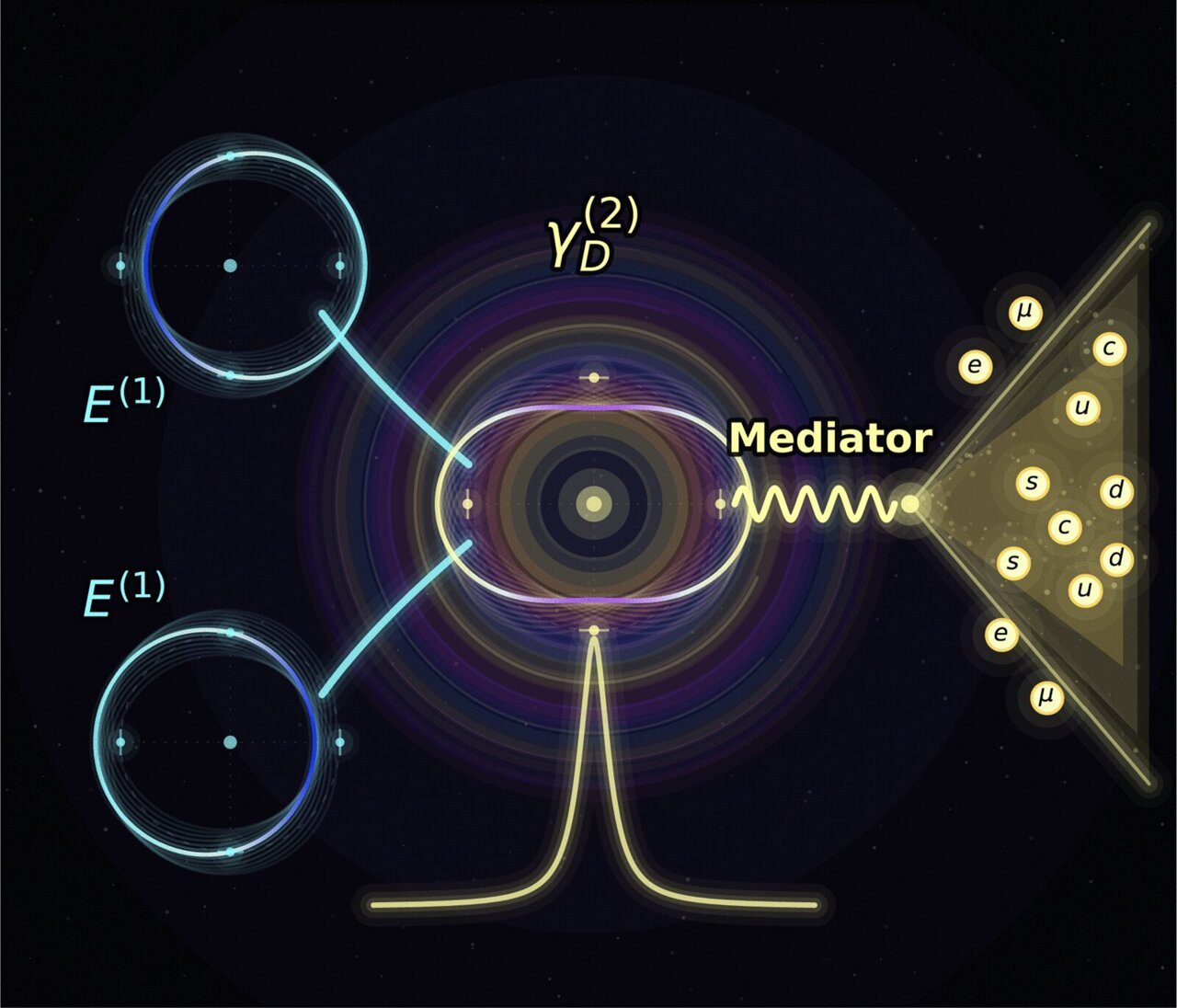
The study proposes that dark matter exists alongside a particle called a dark photon in a hidden extra dimension. According to the theory, the geometry of this dimension causes the particles’ masses to align in a precise way. This alignment creates what is known as a dark matter resonance, similar to how a musical instrument vibrates intensely when it hits the right note.
Dr. Yu-Dai Tsai, a Royal Society Dorothy Hodgkin Senior Research Fellow at the University of Sheffield, explained, “Dark matter resonance is already known to be a powerful idea, with the potential to change our understanding of how dark matter was produced in the early universe and how we search for it today.”
“However, many previous resonant dark matter models have treated the resonance as an assumption. This work gives a possible deeper origin for it: The resonance may come directly from the geometry of hidden dimensions.”
This resonance could make dark matter interactions stronger during key moments in cosmic history, such as in the early universe. Importantly, the model explains why dark matter appears inert and hard to detect today.
Previously, models required careful tuning of particle masses to make the physics work. The Sheffield study suggests that this perfect tuning arises naturally from the mathematical structure of the hidden dimension itself.
“Understanding dark matter would represent a profound advance in humanity’s knowledge of the cosmos and what it is made of,” Tsai added.
“Our research gives physicists clear new targets in the search for dark matter while connecting two of the biggest ideas in fundamental physics: the mystery of dark matter and the existence of hidden dimensions.”
Implications Beyond the Cosmos
The search for dark matter not only expands our understanding of the universe but also drives technological innovation. Ultra-sensitive detectors, cryogenics, low-noise electronics, and quantum measurement technologies developed for dark matter research can lead to breakthroughs in medicine, computing, and global communications.
A New Path Forward
The study by Taegyu Lee and colleagues, titled “Naturally resonant dark matter from extra dimensions,” offers a fresh perspective on one of the most challenging problems in physics. By linking dark matter with hidden dimensions, the research opens new possibilities for both theoretical and experimental exploration.
As scientists continue to probe the mysteries of the universe, this theory provides a compelling framework for understanding the invisible forces that shape our cosmos. It also highlights the interconnected nature of scientific discovery, where advancements in one field can inspire progress in another.
- Author: Tyo Murty




















At the moment there is no comment