
Only 8.7% Wait Until Age 70 for Social Security—Here’s Why It Could Mean Thousands More Every Year
- account_circle Tyo Murty
- calendar_month Wednesday, 29 Jul 2026
- visibility 13
- comment 0 comment
- print Print

info Adjust the font size of this article to get the best reading experience.
Key Takeaways
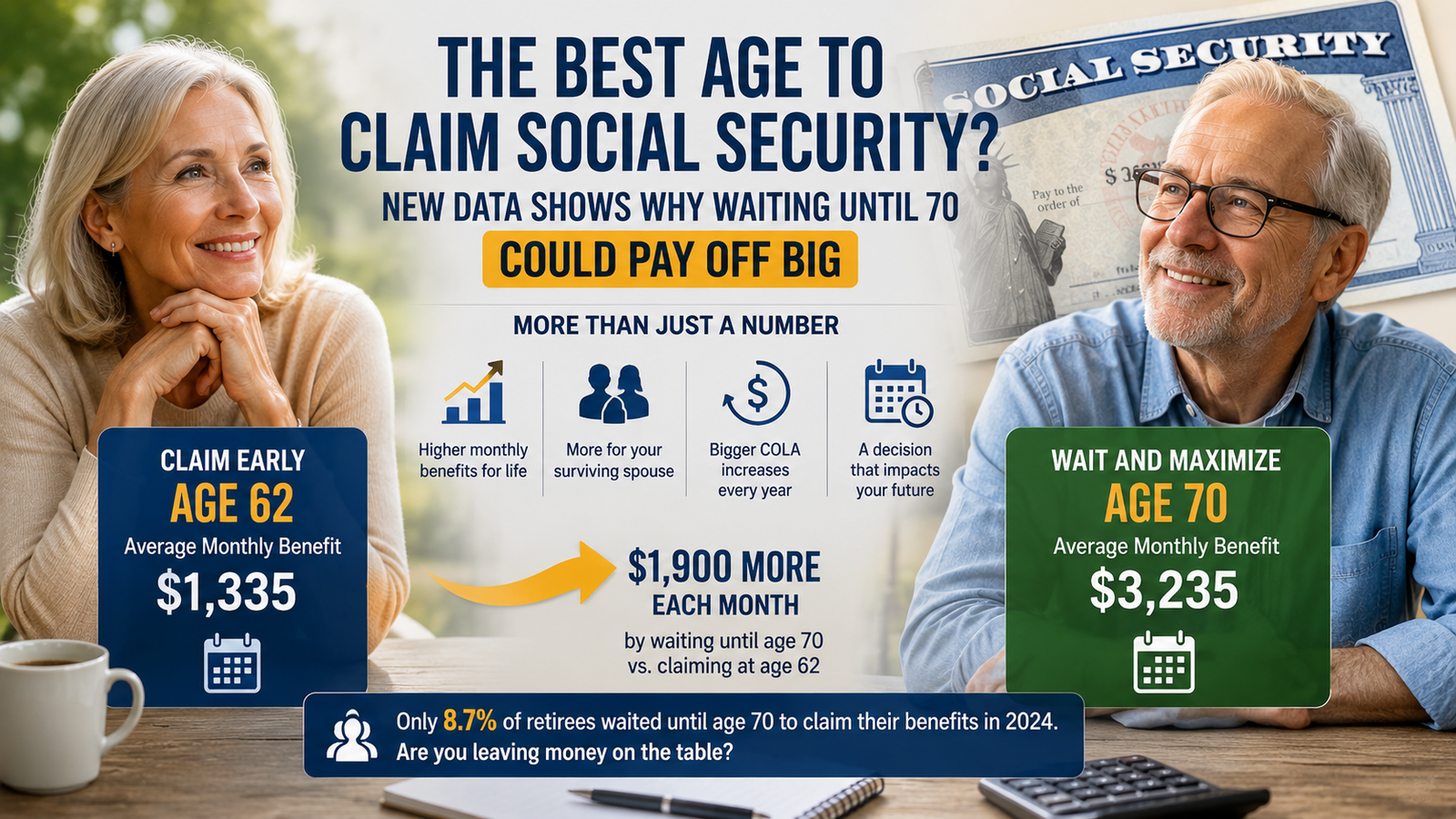
Social Security benefits can be claimed as early as age 62, but each year you delay receiving them increases your monthly payment—up to age 70. In 2024, the average monthly benefit for those who waited until 70 was $3,235, which is $1,900 more than if they had started at 62. Waiting often makes sense if you’re in good health, have other income to live on, and expect to live past your early 80s.
Financial experts typically recommend waiting as long as possible to claim Social Security because the longer you wait, the higher your monthly check will be for the rest of your life. However, this advice isn’t always practical for everyone. Social Security is a crucial source of retirement income, and not tapping into it could mean working longer or struggling financially.
Is holding out really worth it? Let’s look at what the data shows.
How Many People Actually Wait Until 70 to Claim Social Security
Not many people wait until 70. In 2024, over 3.7 million retired workers filed for Social Security benefits, and only 8.7% of them—about 323,376 people—were age 70 or older when they claimed. That means roughly nine out of ten retirees potentially receive less than they could have.
Why so few? Because waiting is difficult, and money is available much sooner. The earliest you can collect Social Security retirement benefits is 62. However, there’s a notable caveat: the sooner you claim, the less you’ll receive per month for the rest of your life.
To get 100% of what’s owed to you, you need to wait until your full retirement age (FRA), which is 67 if you were born in 1960 or later and slightly earlier if you were born before. If you claim at 62, you’ll receive just 70% of what you would have gotten at 67 or your FRA.
But the incentive to wait doesn’t stop there. For each year you delay beyond your FRA, up to age 70, Social Security adds a delayed retirement credit of 8%. That means if you hold out until your 70th birthday, you’ll get 124% of your full benefit (100% plus three years of 8% additions).
Why This Matters
Along with your earnings history, the age you claim is the biggest lever you have over your monthly payment for life—and for a surviving spouse who may outlive you. This single decision can alter monthly payments by hundreds or even thousands of dollars.
What the Average Social Security Benefit Looks Like at Age 70
In 2024, the average monthly benefit for those who waited until 70 was $3,235—or roughly $38,820 per year—according to Social Security Administration (SSA) data. Meanwhile, the average for all ages was $2,275 per month, or about $27,300 a year.
But payments for those who claim early are much lower. At age 62, the average monthly payment was $1,335—meaning those starting at age 70 averaged $1,900 more per month.
The Big Jump in Social Security Benefits From 62 to 70
Keep in mind that these are averages. Your actual benefit depends on your earnings history—specifically, the average of your highest-earning 35 working years, adjusted for inflation.
Your monthly payment can also grow over time. Each year, the SSA may apply a cost-of-living adjustment (COLA) to account for inflation.
Tip
COLAs are calculated as a percentage of your base benefit amount, so a higher starting amount means larger dollar increases every year.
When Waiting Until 70 Makes Sense—and When It Might Not
Waiting until 70 often makes financial sense, but it’s not the right call for everyone. A lot depends on your health, financial needs, life expectancy, and family situation.
A good starting point is establishing your break-even age: the point at which the bigger checks from waiting finally overtake the total you would have collected by starting earlier.
There’s no single, universal break-even age. It varies by person. However, most analyses put it somewhere around age 82 to 83 when comparing claiming at 67 versus 70, and closer to age 80 to 82 when comparing 62 versus 70.
When waiting makes the most sense:
- You’re in good health, have other income to draw on, and expect to live into your mid-80s or beyond.
- You’re the higher earner in a married couple: A surviving spouse can claim your benefit if it’s higher than theirs.
- You’re still working—claiming before the FRA while earning above the SSA’s annual limit can result in your benefit being temporarily withheld.
When claiming earlier might make more sense:
- You have a serious illness, poor health, or a family history of early death.
- You don’t have sufficient income from elsewhere and can no longer work.
In the end, claiming Social Security is a personal decision. But because your choice affects your monthly income for the rest of your life, it’s worth understanding the numbers before deciding when to start.
- Author: Tyo Murty




















At the moment there is no comment