
Gun from World War II Found in German River
- account_circle Tyo Murty
- calendar_month Saturday, 4 Jul 2026
- visibility 15
- comment 0 comment
- print Print

info Adjust the font size of this article to get the best reading experience.
A Historic Discovery in the Neisse River
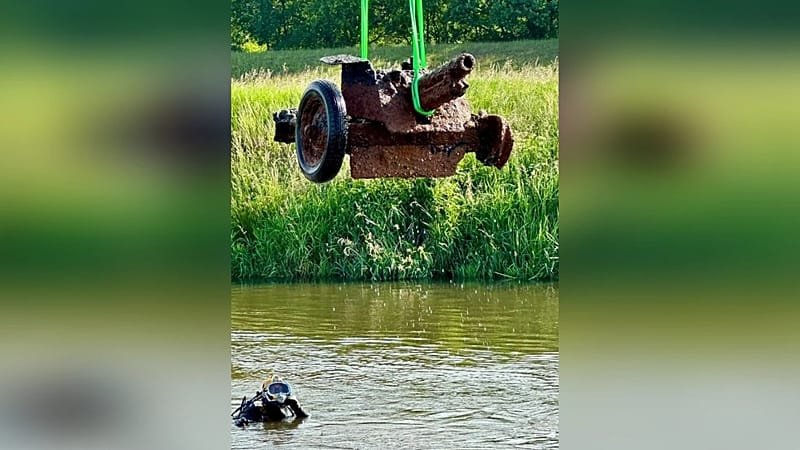
Germany’s Explosive Ordnance Disposal Service (KMBD) recently made a remarkable find near Forst in Lusatia, where they recovered a Soviet Second World War gun from the Neisse river. The discovery occurred during construction work on the waterway, close to the border with Poland, approximately 20 kilometers from Cottbus. This 76 mm infantry gun, model M1943, was used by the Red Army and has been well-preserved despite being heavily rusted.
Enrico Schnick, an expert from KMBD, explained that the gun was preserved in the mud and sand of the Neisse river. He noted that this is an unusual find for the region. “I cannot recall a similar discovery in our area,” he said. The town of Forst, located in Lower Lusatia, was almost entirely destroyed during intense fighting between the German Wehrmacht and the Red Army in April 1945. Today, it has around 17,000 residents and is part of the Spree-Neisse district.
Niederlausitz Aktuell shared videos of the recovery operation, highlighting the careful process involved in retrieving the historical artifact. According to the Berliner Morgenpost, over 5,000 guns of the M1943 type were produced in the Soviet Union during the Second World War. However, this particular gun is not intended for display in a museum. Instead, it is currently at the KMBD’s dismantling facility in Kummersdorf, where it will likely be properly disposed of.
Common Discoveries of WWII Weapons in Europe
The recovery of wartime weapons is not an uncommon occurrence in Europe. In 2025, rail services in Paris were temporarily halted when a bomb was defused. Last year, in Cologne, more than 20,000 people had to evacuate their homes after an unexploded bomb was found. These incidents underscore the ongoing risks associated with remnants of past conflicts.
The discovery of the M1943 gun in the Neisse river serves as a reminder of the extensive military activity that took place in the region during the Second World War. It also highlights the importance of specialized units like the KMBD in ensuring public safety and managing historical artifacts responsibly.
The Significance of the Find
The M1943 gun represents a piece of history that offers insight into the military strategies and technologies of the time. Its preservation in the riverbed suggests that it remained undisturbed for many years, allowing it to retain much of its original structure. This kind of find can provide valuable information for historians and researchers studying the period.
While the decision to dismantle the gun may seem surprising, it reflects the cautious approach taken by authorities when dealing with potentially dangerous relics. The process ensures that any hazardous materials are safely handled, preventing future risks to the community.
Ongoing Efforts in Historical Preservation
The recovery of such artifacts often involves collaboration between local authorities, historical societies, and military experts. These efforts help in understanding the impact of past conflicts and preserving the memory of those who lived through them. In addition, they contribute to the broader narrative of European history, offering a tangible connection to the events that shaped the continent.
As technology advances, so do the methods used in locating and recovering historical artifacts. Modern equipment and techniques allow for more precise and safe retrieval of items that might otherwise remain hidden for decades. This progress is essential in ensuring that historical discoveries are handled with the care and respect they deserve.
Conclusion
The discovery of the M1943 gun in the Neisse river is a testament to the enduring legacy of the Second World War. While the weapon itself may not end up in a museum, its recovery highlights the importance of responsible handling of historical artifacts. As Europe continues to grapple with the remnants of past conflicts, the role of organizations like the KMBD remains crucial in safeguarding both public safety and historical integrity.
- Author: Tyo Murty



















At the moment there is no comment