
The Brutal Night Attack That Shattered Japan’s Myth of American Weakness in the Pacific

info Adjust the font size of this article to get the best reading experience.
Japan Expected the Marines to Break
Before dawn on August 21, 1942, Colonel Kiyonao Ichiki’s first detachment attacked the U.S. Marine perimeter on Guadalcanal near Alligator Creek, also remembered as the Battle of the Tenaru. He advanced with roughly 900 men and believed a determined Japanese night assault could break the Americans.
Instead, the attack became one of Japan’s first major ground disasters of the Guadalcanal campaign. Around 800 Japanese soldiers were killed from a force often listed at 917. The defeat was shocking not only because of the losses, but because of what it revealed.
Ichiki’s men were not poorly motivated. They were trained, aggressive, and willing to die. The problem was that they had been sent forward under a false assumption: that American Marines would collapse when faced with the full force of Japanese offensive spirit. They did not collapse. They held their line.
Japan’s Early Victories Created a Dangerous Confidence
In the first months of the Pacific War, Japanese forces won stunning victories across Asia and the Pacific. The Philippines, Malaya, Singapore, Hong Kong, and the Dutch East Indies all seemed to confirm Japanese confidence in speed, aggression, and fighting spirit.
To many Japanese commanders, these victories appeared to prove a larger truth. Western armies had better equipment and larger economies, but they seemed unable to match Japanese soldiers in determination. When Japanese units attacked hard and fast, Allied defenses often broke.
That lesson was partly misleading. Many of those Allied forces were isolated, badly supplied, poorly coordinated, or caught by surprise. Their defeats were real, but they did not prove that all Western troops lacked courage or discipline.
Still, the pattern shaped Japanese thinking. Americans were often dismissed as soft, materialistic, and unlikely to endure close combat. This was especially dangerous because it turned early success into contempt for the enemy.
The Marines Were Not What Japan Assumed
The U.S. Marine Corps was still relatively small before the war, but it was not unprepared. During the interwar years, Marine officers had studied amphibious warfare, island operations, and the challenge of seizing and defending advanced bases across the Pacific.
That preparation mattered on Guadalcanal. The Marines who landed there were not perfect soldiers. Many were inexperienced, exhausted, undersupplied, and rushed into combat sooner than expected. They had not trained for every difficulty the jungle would throw at them.
But they had a culture built around small-unit leadership, initiative, and holding ground under pressure. When communications failed or plans broke down, junior Marines were expected to keep fighting and make decisions.
Japan saw a small service with limited recent battlefield experience. Guadalcanal revealed a force that could absorb confusion, dig in quickly, and fight with discipline when the moment came.
Guadalcanal Quickly Became a Test of Endurance
U.S. Marines landed on Guadalcanal on August 7, 1942, and captured the unfinished Japanese airfield that became Henderson Field. The landing itself was easier than expected, but holding the island became far more difficult.
After the Allied naval defeat at Savo Island, the Marines were left short of supplies and vulnerable to Japanese counterattack. The fleet’s withdrawal created anger and anxiety among the Marines ashore, who now had to defend a fragile perimeter with limited food, ammunition, medical supplies, and equipment.
Major General Alexander Vandegrift’s division had to hold Henderson Field while Japan rushed troops toward the island. The airfield was the key to the campaign. Whoever controlled it could influence the skies over Guadalcanal and threaten enemy ships in the surrounding waters.
Ichiki’s detachment was part of Japan’s first serious ground response. He was expected to help retake the airfield before the American position became too strong. But Japanese intelligence badly underestimated the strength of the Marine force defending it.
That mistake shaped everything that followed.
Alligator Creek Became a Killing Ground
Ichiki attacked at night, expecting shock and aggression to carry his men through the Marine line. Japanese infantry tactics often emphasized night movement, surprise, and close assault. Against shaken or unprepared defenders, those methods could be devastating.
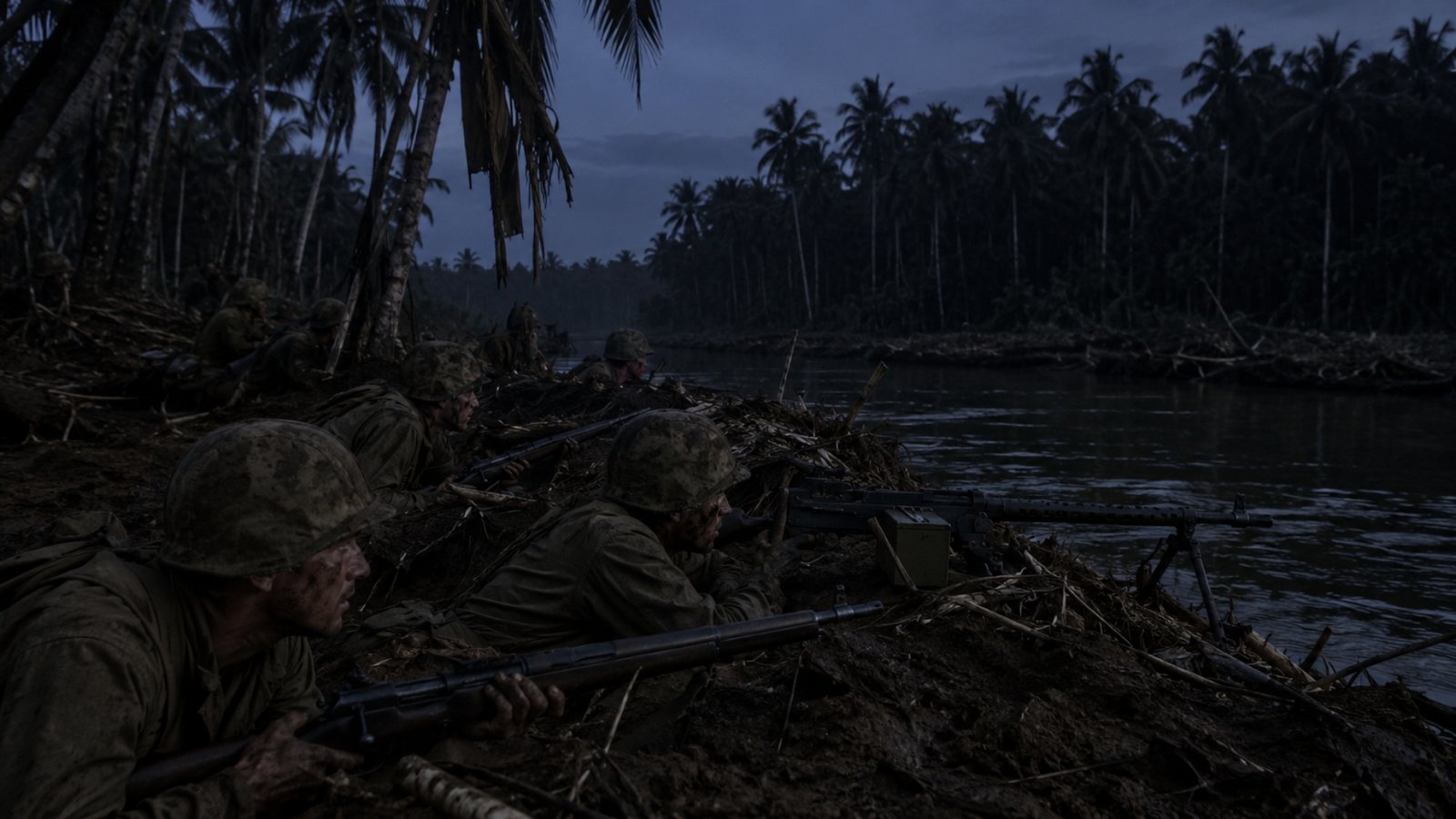
But the Marines near Alligator Creek were not simply waiting in fear. They had prepared defensive positions, placed machine guns, coordinated fields of fire, and brought rifles, mortars, and artillery into the fight. They had been warned that the Japanese were coming.
When the assault moved forward, it met concentrated fire. The Marines did not panic or abandon their positions. They held and forced the attackers into a deadly open approach near the creek and sandbar.
By daylight, Ichiki’s force was trapped and broken. Marine counterattacks, including light tanks, helped destroy the remaining resistance. The scene was brutal, but the military lesson was clear.
The courage of the Japanese soldiers was real. Their attack failed because courage had been sent against prepared firepower without enough intelligence, support, or realistic planning.
The Battle Exposed a Larger Strategic Mistake
The Battle of the Tenaru did not end the Guadalcanal campaign. Japan continued trying to retake Henderson Field, and the struggle lasted for months through jungle fighting, air raids, naval battles, disease, hunger, and exhaustion.
But Tenaru revealed the flaw early. Japan had confused previous Allied defeats with permanent Allied weakness. It had mistaken surprise, poor Allied preparation, and isolated garrisons for proof that Americans lacked fighting will.
Guadalcanal showed something different. When U.S. Marines were dug in, organized, and supported by firepower, Japanese infantry attacks could be shattered.
This was not only a tactical lesson. It was a strategic warning. Japan could still produce brave soldiers and dangerous attacks, but it could not afford to build plans around contempt for the enemy.
The Pacific War would increasingly punish that mistake. As the United States mobilized its industry, expanded its forces, and gained experience, Japan’s belief in spirit over material power became harder to sustain.
A Small Creek Changed the Lesson of the Pacific War
The fight near Alligator Creek was small compared with the vast Pacific War, but its meaning was enormous. Japan had expected American weakness and found Marine discipline instead.
Ichiki’s detachment expected the Marines to break. Instead, the Marines held.
Guadalcanal proved that the United States was not only an industrial power with ships, aircraft, factories, and fuel. It could also produce infantry who would endure, adapt, and defend ground under extreme pressure.
That mattered because the Pacific War was not decided by one quality alone. Courage mattered. Firepower mattered. Logistics mattered. Intelligence mattered. Command judgment mattered. At Tenaru, Japan had courage, but the Marines had the stronger defensive position and the clearer understanding of the battlefield.
The lesson was simple and unforgiving: no army can safely build a strategy on the belief that its enemy lacks courage.
- Author: Tyo Murty














At the moment there is no comment