
Meet the Asaro Mudmen, Papua New Guinea’s Masked Warriors
- account_circle Tyo Murty
- calendar_month Saturday, 18 Jul 2026
- visibility 13
- comment 0 comment
- print Print

info Adjust the font size of this article to get the best reading experience.
The Mysterious Asaro Mudmen of Papua New Guinea
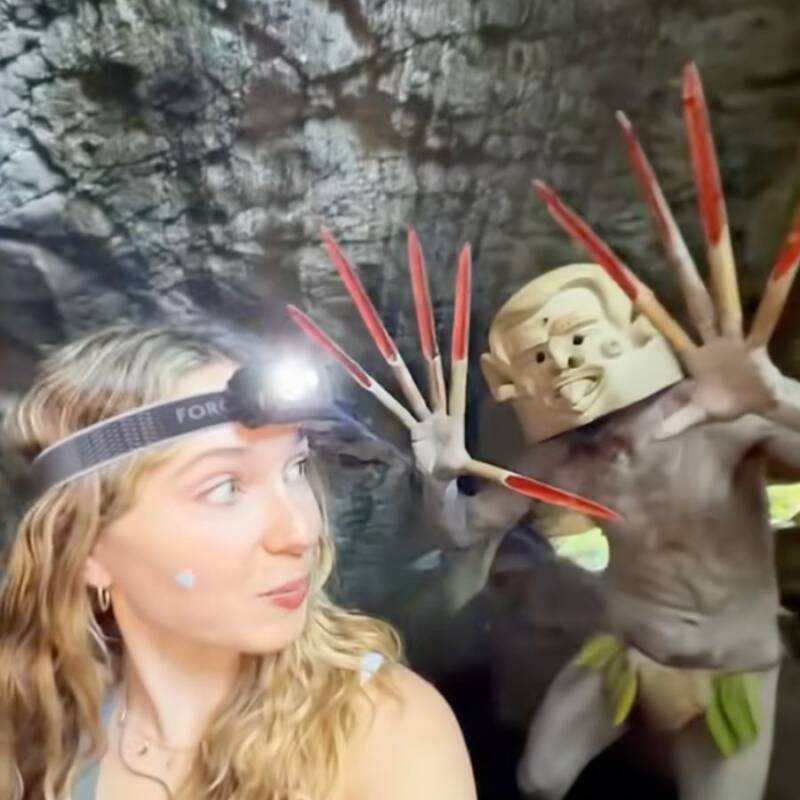
If you travel through the highlands of Papua New Guinea, you may encounter a group of men who look like living ghosts. Their bodies are covered in pale clay. Some brandish long claws made of bamboo; others wear grotesque masks complete with bulging eyes, sharp tusks, and twisted horns. These are the Asaro Mudmen, one of Papua New Guinea’s most recognizable cultural fixtures.
Their strange appearance has fascinated outsiders for generations — and, in the age of TikTok, has made the country a destination for adventurers seeking a unique cultural experience. But who are the Asaro Mudmen, and how did this peculiar tradition develop?
An Introduction to the Asaro Mudmen
In a video with over five million views, a TikTok user shows herself in a cave. Surrounding her are two Asaro Mudmen, both covered in white clay and wearing frightening masks. According to the user, this look has a practical purpose. Specifically, she says that these are “warfare, tribal outfits” that the people used to “scare the enemies.”
Whether this is actually the case, however, is a complicated question. According to one telling, the group was once defeated in battle and forced to flee. Seeking refuge, they settled near the Asaro River, which was filled with light mud. Resting on its shores, the people became covered in the mud, giving their skin a pale hue. By the time they met their enemies once again, their foes were terrified. They believed that they were not seeing men, but ghosts or spirits — and thus, they fled, making the Asaro people the victors and creating a new battle tradition.
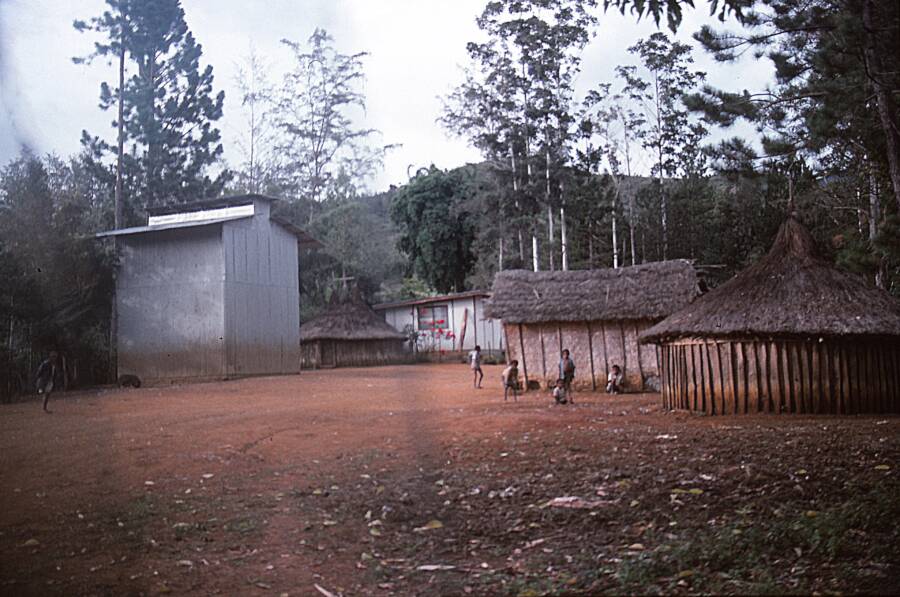
However, whether this is actually the story of the Mudmen’s origin is debated. Instead, anthropologists say that the modern practice may be a mix of several earlier traditions adapted into a single act.
How Did the Asaro Mudmen Come to Be?
In 1996, anthropologists Ton Otto and Robert Verloop published a study on the history of the Asaro Mudmen based on fieldwork by Verloop and Nick de Heer. To understand the practice, the pair sorted through a variety of oral histories from residents to piece together a coherent narrative. Their work largely relied on the words of Ruipo Okoroho, the acknowledged chairman of the Mudmen.
According to one origin story explored in the study, the Mudmen practice emerged in the village of Komunive. In the late 1800s, a man named Bukiro Pote spent several years in the nearby Watabung area. There, he learned about a practice called bakime, in which a fighter would cover themselves with white sap from the meniha tree before an attack. This had a largely practical purpose. By painting their face, the attacker could disguise their identity, making it difficult for anyone to recognize them and retaliate against them or their family.
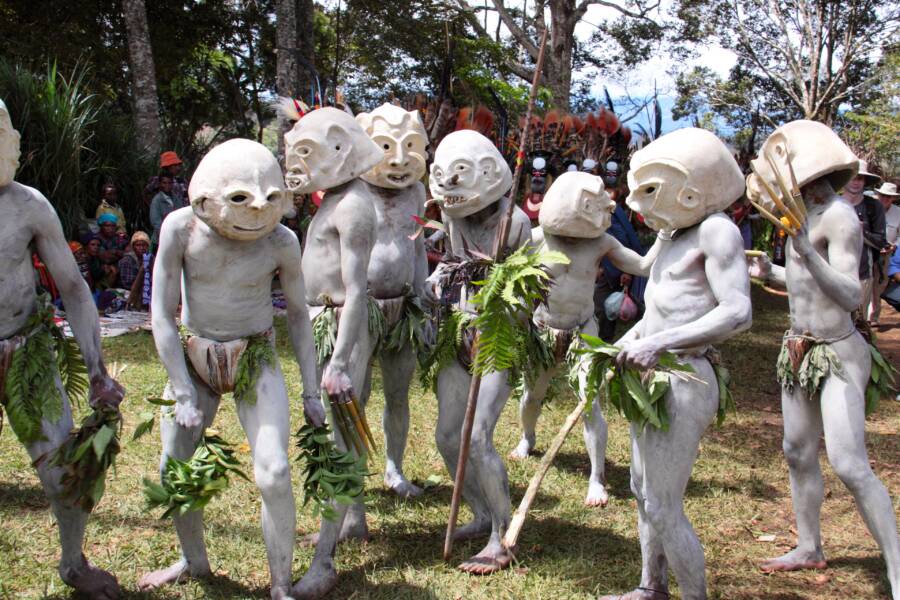
When Bukiro returned home, he began adapting the practice. What came next was called girituwai. In contrast to bakime, girituwai involved creating a mask from a bamboo frame and a bilum bag with holes cut for eyes. From there, mud was smeared across the bag. In both cases, the face coverings were not normal battle dress. Instead, these looks were only used for targeted attacks. Warfare had specific, traditional regalia; assassinations or retaliatory attacks, in contrast, could employ one of these disguises.
However, this is not the only explanation for the origins of the look. In another telling, an Asaro man lacked a traditional wedding costume. In its place, he decided to wear a mask and cover himself in mud — resulting in wedding guests believing he was a ghost and fleeing.
While it’s unclear when the Asaro people began covering themselves in mud, body painting practices were certainly present in the highlands of Papua New Guinea from an early age. For example, men around Mount Hagen sometimes covered their bodies in charcoal before fighting. This was both to conceal themselves and to appear more formidable. There’s also evidence of people in the area covering their bodies in clay, but this was often done to mourn those who were lost in battle.
How This Practice Adapted Over Time
In 1957, organizers for the inaugural Eastern Highlands Agricultural Show in Papua New Guinea asked Ruipo Okoroho, acting as a representative for the Asaro people, to present a demonstration of the community’s heritage. Remembering stories of girituwai disguises from past generations, Okoroho met with other leaders from the community and decided to revive the practice — with a twist.
Rather than the simple bag-and-bamboo constructions of yore, the community would create elaborate masks with threatening faces. They would also cover their bodies in white clay. When the group presented their work at the Eastern Highlands Agricultural Show, attendees were immediately captivated. In subsequent years, their presentations became grander, employing more grotesque masks and developing a specific, spirit-like performance to go along with the outfit. These masked performers came to be known as holosa, meaning “ghosts.”
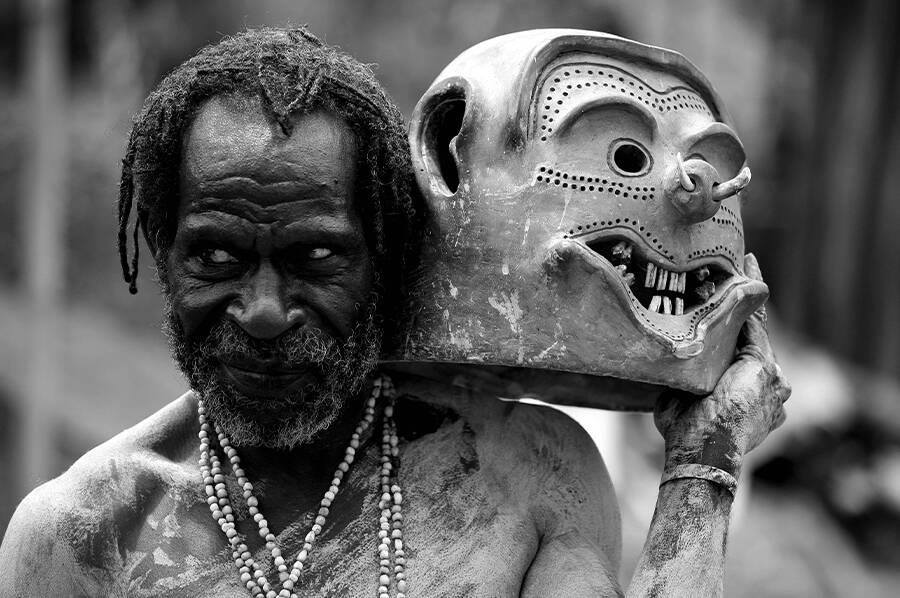
Since the 1950s, holosa performances have become more elaborate, with the look changing to appeal to crowds and tourists. While the masks were originally composed of bamboo, performers later made masks out of banana root and, eventually, clay, reportedly in response to viewer preferences and local material availability. There’s also evidence that they changed the masks’ expressions, going from threatening and angry to showing a wide range of emotions, including happiness.
So, where did the original tale of the Asaro warriors getting covered in mud while hiding beside a river come from? It’s unclear. It could be a mix of a genuine experience and later exaggerations, or it could simply be a folk tale that has emerged over the years through repeated exchanges between villagers, writers, and tourists.
While some responded to the video questioning if the person was in danger, it’s safe to say they were not. This is a tourist presentation — and one that brings income and attention to the Asaro people. Regardless of the practice’s origin, it’s pretty incredible to see, and certainly an interesting way to spend a vacation.
- Author: Tyo Murty




















At the moment there is no comment