
Happy Birthday to the Growing Security State
- account_circle Tyo Murty
- calendar_month Wednesday, 15 Jul 2026
- visibility 15
- comment 0 comment
- print Print

info Adjust the font size of this article to get the best reading experience.
The Origins of the National Security State
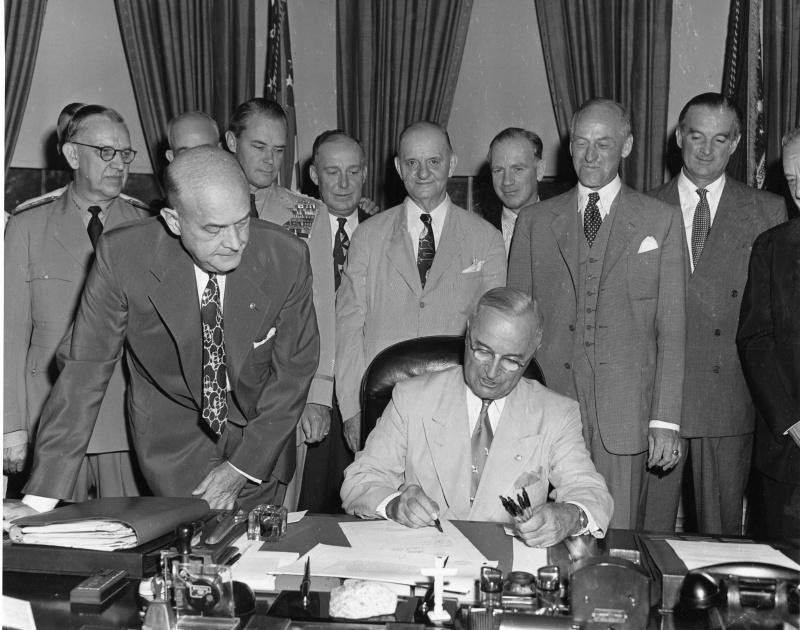
Seventy-nine years ago, President Harry Truman signed the National Security Act, a piece of legislation that would eventually evolve into the vast and often controversial national security state we know today. With this action, Truman laid the groundwork for an intricate network of intelligence and military organizations that would grow in power and influence over the decades.
The act created several key institutions, including the National Security Council (NSC), which was designed to advise the president on matters related to national security. It also ensured that each branch of the military retained its own intelligence functions, while establishing the Central Intelligence Agency (CIA) as the primary organization responsible for coordinating and unifying intelligence activities.
Within just a decade, the CIA was joined by other agencies such as the Intelligence and Research Bureau (INR) within the State Department, the Air Force Security Service (USAFSS), the Office of Special Investigations (OSI), and the National Security Agency (NSA). These organizations were formed in response to the growing complexities of global politics and the perceived threat posed by the Soviet Union during the Cold War.
The Role of the Soviet Threat
While many believe that the creation of these secretive organizations was an inevitable result of World War II and the Cold War, historians argue that the National Security Act was also driven by what can be described as “naked opportunism.” Truman, a determined leader, took full advantage of the opportunity presented by the largest war in history to reshape the national security establishment.
Although his intentions were not necessarily malicious, the consequences of this restructuring have been significant, particularly when it comes to civil liberties. The centralization of power allowed for the migration of German scientists into the United States, some of whom had ties to war crimes against political prisoners, Romani people, and Jews. These individuals, along with others granted access to funding and restricted data, continued to conduct experiments on human subjects, including U.S. service members, pregnant women, prisoners, and children with mental disabilities.
Abuse of Power and Surveillance
U.S. intelligence agencies, including the FBI, CIA, and NSA, have repeatedly abused their government-granted secrecy to surveil Americans domestically. This has included monitoring civil rights activists like Martin Luther King Jr., antiwar protestors during the Vietnam War, and even notable figures such as Albert Einstein and Aretha Franklin. Journalists, actors, elected officials, and Nobel laureates have also been targeted under the guise of national security.
These abuses were so severe that in 1976, a special Senate committee known as the Church Committee spent years investigating the extent of the CIA, FBI, and NSA’s misconduct. Their findings were documented in seven volumes and six books, revealing the shocking scale of surveillance and espionage conducted by these agencies.
As a result of these revelations, Congress passed the Foreign Intelligence Surveillance Act (FISA) in 1978 to impose strict judicial oversight on government surveillance. The Church Committee’s work also led to the creation of a permanent Senate Select Committee on Intelligence to monitor national security entities. An executive order was issued banning any U.S. government employee from engaging in political assassinations, although actions such as destabilizing regimes, supporting coups, and aiding armed groups remain permissible.
The Ongoing Debate Over Oversight
Despite these measures, questions about the abuse of national security powers are often met with skepticism. Critics are frequently dismissed as paranoid or accused of baseless hysteria. Some claim that the national security state is carefully designed to target only a narrow class of individuals, as former Attorney General John Ashcroft suggested.
To reassure the public, former CIA Director Richard Helms argued that the nation must “take it on faith” that those working in the intelligence community are honorable men devoted to the country’s service. He also claimed that oversight needs are “adequately served” by congressional committees.
However, Helms’ own actions cast doubt on this claim. He ordered the destruction of thousands of files related to the CIA’s support for illegal human experiments. Additionally, multiple revelations about unconstitutional surveillance activities post-9/11 suggest that safeguards like FISA have lost much of their effectiveness.
The Legacy of the National Security State
The United States faces real threats from enemies abroad, but the machinery built nearly 80 years ago to confront them has been consistently misused. The question is no longer whether the national security state works—it is why Americans continue to pretend it does.
- Author: Tyo Murty
















At the moment there is no comment