
Offshore Wind Power Keeps New England Lit During Record Heat

info Adjust the font size of this article to get the best reading experience.
How Offshore Wind Contributed to Grid Stability During Extreme Heat
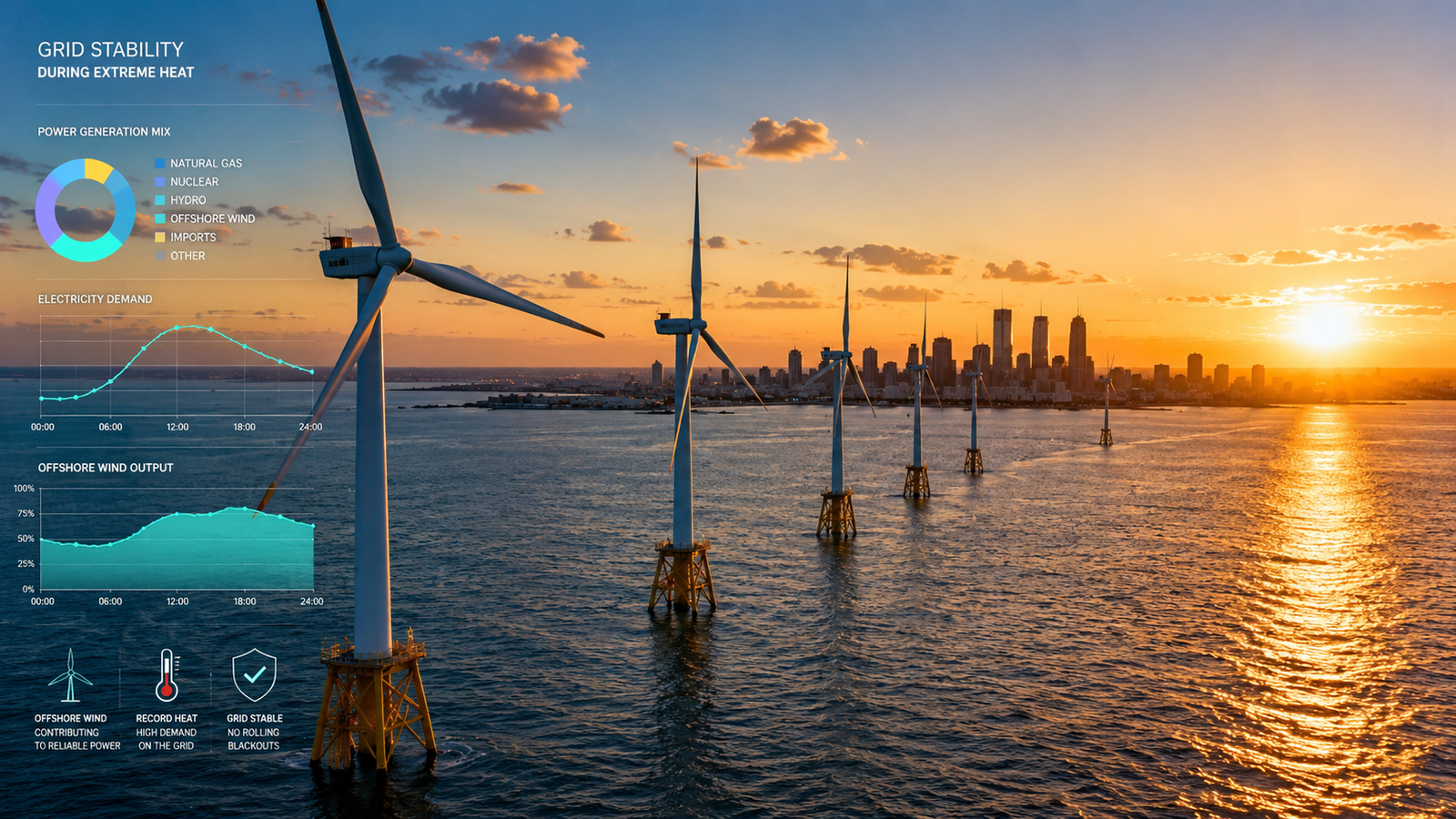
New England’s power grid managed a record-breaking summer heatwave without experiencing rolling blackouts, and offshore wind generation played a significant role in maintaining supply levels above demand. The region’s grid operator, ISO New England, successfully handled peak electricity loads during the heatwave by leveraging a diverse mix of energy sources, including output from offshore turbines located along the southern New England coast. This achievement occurred despite the temporary shutdown of Vineyard Wind, one of the region’s most prominent offshore wind projects, following a blade failure that triggered a federal suspension order.
The performance of offshore wind during this critical period raises an important question: did it actually deliver meaningful power when the grid needed it most? Federal grid data tracked by the U.S. Energy Information Administration (EIA) through its real-time dashboard for ISO New England provides some insight into this. The dashboard offers near-real-time generation and demand data for the balancing authority, allowing for comparisons between load peaks and the resource mix feeding the grid during the hottest hours.
Heatwaves place unique stress on power systems. Air conditioning demand surges in the afternoon, natural gas plants operate at or near capacity, and grid operators must secure every available megawatt. Offshore wind typically experiences stronger winds during the afternoon and evening along the Atlantic coast in the summer, aligning with the times when air conditioning loads are highest. This timing overlap is a key reason why offshore wind contributed to grid stability rather than remaining idle when it was needed most.
While the hypothesis that offshore wind capacity factors exceeded seasonal norms on high-demand days is consistent with known coastal wind patterns, isolating the exact megawatt contribution from offshore turbines requires granular hourly generation data broken out by fuel type. The EIA grid monitor publishes aggregate generation by source category for ISO New England, but publicly available breakdowns do not always separate offshore wind from the broader “wind” category in every reporting interval. This gap limits the precision of claims about exactly how many megawatts offshore wind added during peak demand.
Despite these limitations, the pattern in public data is instructive. During the hottest afternoons, total wind output in ISO New England did not drop to zero; instead, it fluctuated at levels that suggest at least some contribution from offshore facilities. Because offshore projects typically experience steadier winds than many onshore sites in New England, it is reasonable to infer that a portion of the recorded wind generation came from turbines at sea. In effect, offshore wind acted as one leg of a broader reliability stool that also included gas-fired plants, nuclear units, hydropower, and imports from neighboring regions.
For grid operators, the practical question is not whether offshore wind alone could have met the peak, but whether its presence reduced the amount of other capacity that had to be dispatched. The EIA data show that natural gas plants still carried the bulk of the load, yet they did so alongside non-zero wind output during the tightest hours. Each megawatt delivered by offshore turbines was one less megawatt that had to be squeezed from aging peaker plants or emergency imports, helping to preserve operating reserves and avoid more drastic measures.
Vineyard Wind’s Blade Failure and the Fleet That Kept Running
Any accounting of offshore wind’s summer performance must consider the disruption at Vineyard Wind, the largest U.S. offshore wind project. On July 13, 2024, a blade failure occurred at the project, according to the federal safety regulator. The Bureau of Safety and Environmental Enforcement (BSEE), which oversees energy activities on the Outer Continental Shelf under the U.S. Interior Department, issued a suspension order halting both power production and construction at Vineyard Wind in response to the incident.
That suspension removed generating capacity from the regional fleet at a time when every megawatt counted. Yet the grid did not falter. The reason is that Vineyard Wind was not the only offshore resource available to ISO New England. Other turbines in the region continued to operate and feed electricity into the transmission system. The blade failure was a serious engineering and regulatory event, but it did not represent a systemic failure of offshore wind as a resource class. BSEE’s incident tracking through its SafeOCS platform and production records available through its public data portal document the scope of the disruption, but they also confirm that the suspension applied specifically to Vineyard Wind rather than to all offshore operations in the region.
The distinction matters for grid planning. A single-project outage, even at a large facility, is the kind of contingency ISO New England routinely manages across all fuel types. Gas plants trip offline. Transmission lines go down. The grid is designed to absorb individual failures without cascading into blackouts. Offshore wind’s performance during the heat wave, with one major project sidelined and others still producing, demonstrated that the technology can function within that same reliability framework.
It also underscored the value of geographic and technological diversity within the offshore fleet itself. Concentrating too much capacity in a single project exposes the system to project-specific risks, whether mechanical, regulatory, or financial. Distributing capacity across multiple lease areas and turbine designs can limit the impact of any one failure. The heat wave episode, in which Vineyard Wind was offline but other marine turbines continued to generate, offered an early glimpse of how such diversification can play out in practice.
Gaps in the Public Record and What to Watch Next
Several questions remain open. No public primary dataset currently isolates offshore wind output from onshore wind in ISO New England’s real-time reporting at the hourly level needed to calculate precise capacity factors during the heat wave’s peak days. The EIA grid monitor groups wind generation together, and BSEE’s Outer Continental Shelf production logs were designed for oil and gas operations rather than for tracking electricity output from wind turbines in near-real time. That means the strongest version of the claim—that offshore wind capacity factors exceeded seasonal norms on the highest-demand days—cannot yet be confirmed or denied with publicly available federal data alone.
ISO New England has not released a detailed public attribution statement specifying the exact megawatt contribution of offshore wind versus natural gas, nuclear, hydro, or imports during the peak hours. Without that breakdown, the precise share of credit that belongs to offshore wind remains an estimate rather than a verified figure. Grid operators have internal telemetry that captures this information, but it has not appeared in a public report tied to the specific heat wave event.
The Vineyard Wind suspension also raises unresolved questions about the project’s timeline for returning to service. BSEE’s order covers both power production and construction, which means the project cannot resume generating electricity or installing additional turbines until the agency lifts the suspension. The root cause investigation into the blade failure will determine how long that takes and whether design or manufacturing changes are required before operations can restart at full scale. Any mandated modifications could ripple through construction schedules, financing plans, and the broader pace of offshore build-out in southern New England.
For policymakers and grid planners, the episode points to two parallel priorities. First, improving the transparency of real-time and historical data on offshore wind output would allow more rigorous assessments of how these projects perform during system stress events. Second, integrating offshore wind into reliability planning means treating it like any other major resource: subject to outages, backed by contingency reserves, and evaluated based on empirical performance rather than assumptions.
As New England faces more frequent extreme heat events, the region’s experience this summer suggests that offshore wind can contribute to keeping the lights on, even when one marquee project is sidelined. The full story of how much it helped, and how quickly projects like Vineyard Wind can return from unexpected setbacks, will depend on the data and disclosures that emerge in the months ahead.
More from Morning Overview
‘The NSA issues an urgent warning to all phone users about a setting most people leave on
5,000-year-old wolves on remote island upend domestication theory
Scientists may have found a Type II civilization
EPA finally kills ‘stupid feature’ in 60% of U.S. cars after 14 years of driver rage
*This article was researched with the help of AI, with human editors creating the final content.
- Author: Tyo Murty




















At the moment there is no comment